Showing posts with label Passover(Pesach). Show all posts

Sunday, April 01, 2007

The Passover Lamb


I had heard before about how the Passover Lambs had been brought into the homes of the Jewish families in Egypt and cared for prior to being sacrificed. The book I am currently reading has a good summary of this that I'm going to share word for word with you because I just don't think I can paraphrase it any better than they've put it.


Christ in the Passover
by Ceil & Moishe Rosen

"God began His object lesson to Israel with the Passover lamb. First, the people had to single out from their flocks the handsomest, healthiest looking yearling. An animal of this age, just approaching the prime of its life, was frisky and winsome. Then the family had to watch it carefully for four days before Passover to make sure it was perfect in every way. During this period of close observation, they fed and cared for the lamb and grew accustumed to having it around. By the end of the fourth day, it must have won the affection of the entire household, especially the children. Now they all must avoid its big, innocent eyes as the head of the house prepared to plunge in the knife. While meat was a treat in ancient times, how could they enjoy eating their lamb's flesh? The lesson was painful. God's holiness demands that He judges sin, and the price is costly. But He is also merciful and provides a way of escape (redemption).

The innocent Passover lamb foreshadowed the One who would come centuries later to be God's final means of antonement and redemption."

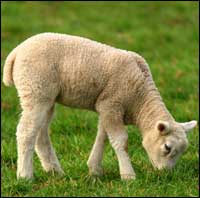
Can you imagine having picked out a cute fluffly lamb like the one pictured above on Thursday. It is living in your home with you, your kids play with it, you care for it and feed it, and then come tomorrow at sundown you'll have to sacrifice it? Think of how hard that would be. Now you can just start to understand what Jesus did for us!

Passover - (Pesach)

Tomorrow (April 2nd) at sundown is the beginning of Passover, lasting until sundown on Tuesday, (April 3rd). After Passover (Pesach) begins the Feast of Unleavened Bread lasting seven days.

I've found a wonderful article on First Fruits of Zion regarding these two Feasts of the Lord (often referred to collectively as Passover in our modern times). Most articles on this site require membership, however you can join for free to receive emails and to access a treasure of resources. I recommend membership to anyone wanting to learn more about the Lord and Christianity's Jewish roots.

The article I found is Passover - Remembering Our Redemption. It does require membership to read the entire article, however it takes only a few moments to join and is definitely worth it! I recommend taking the time to read this in honor of this upcoming Feast.

Wednesday, March 21, 2007

Blood on the Door - Passover


Take a bunch of hyssop, dip it into the blood in the basin and put some of the blood on the top and on both sides of the doorframe. Not one of you shall go out the door of his house until the morning.
~ Exodus 12:22

At the first Passover the blood of the lamb on the doorposts set apart the homes of those who believed and obeyed God from the homes of those who did not. The blood was a special mark for those who feared the Lord, which exempted them from the coming destruction. This is not the only time a special mark is used to single out and save those who followed the Lord.

In Ezekiel 9:4-6, Ezekiel has a vision from God regarding Jerusalem in which a man clothed in linen with a writing kit went through the city and marked the foreheads of those who "grieved and lamented the detestable things" done in the city. Other men armed with "deadly weapons" followed and slaughtered "without pity or compassion" those without the mark, whether women, men or children.

In Revelation a special mark on the forehead seals the 144,000 prior to the four angels being given power to harm the land and sea (7:2-3) Later the locusts released from the Abyss are instructed not to harm those marked on the forehead as believers/followers of Christ in Revelation 9:4.

To better understand the sealing of the early Israelites it helps to have knowledge of what the ritual would have entailed. The basin mentioned in Exodus 12:22 was a ditch dug in front of the doorway. This was done in Egypt at that time to avoid flooding and would have held a container to avoid seepage.

The Passover lamb would have been killed by the Israelites right by their doors, therefore the blood would have ran into the ditch and collected in the basin. A hyssop branch would have been dipped into the blood caught in the basin and touched first to the lintel (top horizontal part of the doorframe) and then to each side post. In this way, the door was effectively "sealed" on all four sides (the basin on the bottom, the lintel on the top and the door posts on each side). Those within the home were also considered to be "sealed" by the Lord as followers and therefore exempt from the Angel of Death passing through that night. (Note, none were allowed to go out the door of the home until morning in order to be "sealed".)

Even more thought provoking is the fact that Jesus says in John 10:9, "I am the gate; whoever enters through me will be saved. He will come in and go out and find pasture."

The Israelites of that first Passover went in through their blood-sealed doors that night and found safety. They were protected and redeemed by the sacrificial blood. The next morning they went out and began a journey to the Promised Land, their good pasture.

For us, the exemption seal is the blood of Christ (our Passover lamb). When we believe and obey Christ we are entering through Him, our gate. We then go out and begin our journey to the "Promised Land" of a future, eternal haven built by the Lord, where we will spend eternity in His Presence.


(Thanks to be given to Christ in the Passover by Ceil & Moishe Rosen)


Monday, March 12, 2007

Leaven


Passover (Pesach) this year begins at sundown on April 2nd and ends at sundown April 3rd. On the Hebrew calendar this Feast falls on Nisan 14. With the upcoming Feast I figured now would be a good time to start posting what I’ve been learning about the Feasts of the Lord again. Today I’m gong to be posting about leaven and the symbolism of the unleavened bread eaten at Passover.


That same night they are to eat the meat roasted over the fire, along with bitter herbs, and bread made without yeast.


Exodus 12:8


One of the traditions of the Passover meal is to eat unleavened bread. When the Hebrews left Egypt they were instructed by the Lord to eat unleavened bread that night with their Passover lamb and bitter herbs. In addition, they were not to eat leaven for another seven days (the Feast of Unleavened Bread).

Jews take this very seriously, in that they not only ensure they eat bread without leaven, they clear the entire home of leaven. Preparations for Passover usually begin up to a month prior to Passover in order to clean the home from top to bottom to ensure there is no leaven left. (For tips on preparing your home for Passover visit Preparations for Passover at Hebrew for Christians.)

While many know this tradition symbolizes the haste in which the Hebrews left Egypt, there is an even deeper meaning to be found.


Your boasting is not good. Don’t you know that a little yeast works through the whole batch of dough? Get rid of the old yeast that you may be a new batch without yeast – as you really are. For Christ, our Passover lamb, has been sacrificed. Therefore let us keep the Festival, not with the old yeast, the yeast of malice and wickedness, but with the bread without yeast, the bread of sincerity and truth.


1 Corinthians 5:6-8


This passage is powerful, however understanding the underlying concepts makes it come even more alive.

The Hebrew word for leaven is chometz which means bitter or sour. In the Bible, leaven is almost always a symbol of sin. The Hebrew word for unleavened bread is matzo which means sweet, without sourness.

Jesus even refers to leaven as false doctrine and hypocrisy. (see Matthew 16:11-12, Mark 8:15 and Luke 12:1)

Why is leaven so often used to symbolize sin?

Just a little amount of leaven (yeast) permeates the entire batch and causes dough to rise and become puffed up. It adds volume to the bread while remaining at the same weight. This is similar to when we become prideful and puffed up, thinking we are more than we really are.

During the time of the first Passover Jewish women used the sourdough method of making bread. This consisted of tearing off a chunk of the raw dough to be set aside in a cool moist place prior to forming the dough into loaves to be baked. The next time a batch was prepared for baking, this chunk would be mixed in with the new dough of flour and water and a new chunk would be torn off and set aside for the next batch. By doing this each “generation” of bread was linked by common yeast spores to the previous loaves.

This parallels our sin nature passed down from Adam, which connects each of us to the rest of the human race. Sin left unchecked will quickly flourish and multiply, permeating the entire batch of dough (our life, our community, etc). By becoming a new batch without sin we become like unleavened bread, which is sweet with sincerity and truth, no longer full of malice and wickedness.

For the Hebrews, the putting away of leaven symbolized breaking the cycle of sin and starting a fresh new walk with the Lord. They put away the leaven not to become redeemed (this occurred when they spread the lamb’s blood on their doorposts) but because they were redeemed!


_____________________

Information for this post was gleaned from Christ in the Passover by Ceil and Moishe Rosen and Hebrews for Christians at www.hebrew4christians.com


Wednesday, May 03, 2006

Passover - Fulfillment


The symbolism of Passover was fulfilled by Jesus when He first came to this earth as our Messiah. Here are some examples:

1. Three matzahs & breaking of the middle matzah
Rabbinic tradition has held that the three matzahs represent the three types of Jewish people: the priests, the Levites, and the Israelites. Another tradition says they represent the three patriarchs: Abraham, Isaac and Jacob. Yet neither of these explain the broken matzah.

The three matzah represent the trinity of the Godhead: Father, Son and Holy Spirit. The middle matzah which is broken represents the Son, Jesus. He was broken (died), wrapped and hidden away (buried) and brought back at the third cup of wine (resurrection on the third day).

2. Passover Lamb
Passover foreshadowed the Jewish Messiah as the true Passover Lamb, as spoken about by Isaiah (Isaiah 53). He would be innocent and pure. He would shed His blood to provide deliverance for the nations.

Monday, May 01, 2006

Passover - Part 2


It's been awhile since I last wrote about the Feasts of the Lord. We are starting to study the End Times in my simple church on Tuesday nights. This should go along well with the three fall feasts since they relate to Christ's second coming.

There is so much I could write about Passover, but I'm going to let you do more research if you are interested. I can give you some resources that I've found but I want to get on to the other Feasts as well. I could probably continue to write about Passover for quite some time if I let myself.

Today, I'm going to share with you the meaning of the four cups of wine from the Passover meal.

The First Cup - This cup is poured by the father who asks everyone to rise. He then raises the cup to heaven and recites the prayer of sanctification (Kiddush). This sets the day apart to God.

Blessed art Thou, O Lord our God, King of the universe, Who createst the fruit
of the vine. Blessed art Thou, O Lord our God, Who hast chosen us for Thy
service from among the nations . . . Blessed are Thou, O Lord our God, King of
the universe, Who hast kept us in life, Who hast preserved us, and hast enabled
us to reach this season.

Jesus said the Kiddush as the leader of the Seder service in the Upper Room.
"Then He took the cup, and gave thanks." Luke 22:17

The Second Cup - The second cup is poured and in response to four questions a lengthy narrative of the Passover story is shared beginning with Abraham in Ur. As the ten plagues are described a tiny bit of wine is poured out for each plague to represent the sorrow felt for the Egyptian's suffering. Once the first half of the praise psalms (Hallel) is recited the second cup is taken.

The Third Cup - This is called the Cup of Redemption. It is at this point that Jesus instituted the Lord's Supper as we know it as a reminder of His redemptive work on the cross. Since Passover is closely associated with the hope of the coming of the Messiah, a child is sent to the front door after the third cup to welcome in the prophet Elijah. It is believed based on scripture that he would appear, drink the cup and announce the Messiah.

"I will send you Elijah the prophet Before the coming of the great and dreadful day of the Lord." (Mal. 4:5)

The Fourth Cup - Known as the Cup of Acceptance or Praise. This is the cup that Jesus said He would not drink until He drank it with His disciples in the Kingdom. Jesus realized His time of acceptance by the Jews was still yet in the future.

As I said above there is so much more to this celebration and meal which I encourage everyone to look into further. At this time though I'll be moving on the the next Feast of the Lord, the Feast of Unleavened Bread after I post regarding the fulfillment of Passover by Jesus, the Messiah.

Here is a site I've found with alot of information about the Passover celebration

Judaism 101 - Pesach: Passover

Friday, April 21, 2006

Passover - Part 1

I know Passover for this year has already passed, but since I'm still doing a study of the Lord's Feasts and this is the first one, that is what I'll be talking about today.

First I want to say I attended a Passover dinner put on by a local church this year. We actually did this on Friday night (4/14) although the actual Passover began this year at sundown, April 12th. Passover was meant to be celebrated in a smaller intimate setting than what I experienced from this Passover meal, however it was a wonderful learning opportunity for me. I believe my house church group (about 12 of us, not counting the children) will be celebrating next year in a more intimate setting.

"On the fourteenth day of the first month at twilight is the Lord's Passover." (Lev. 23:5)
Nisan 14th

Exodus 11 - In this chapter the 10th plague is described as occurring at midnight when God would pass through the land and kill the firstborn of all families and cattle.

Exodus 12 - God outlines the steps to be taken by His people who trusted Him in order to avoid the plague, in order to be "passed over".


Requirements for Passover

* A year old male lamb, perfect with no flaws or defects was to be taken from the flock on the 10th of Nisan

* For four days the family was to take the lamb into their homes to ensure it was fit for the sacrifice and to become attached to the lamb. In this way the lamb became "their lamb".

* At sunset on the 14th day of Nisan the lamb was to be publicly killed and the family was to apply the blood of the lamb to their doorpost.

* The innocent lamb became a substitute so the Lord's judgment "passed over" the family.

At the time of the first (and true) Passover, the month of Nisan became the first month in the Jewish religious calendar.


God's requirements for the Passover Meal

God required three items for the Passover Meal to be eaten:

1. Lamb - a young lamb was chosen to symbolize innocence. It was roasted over a fire to symbolize the judgment of the first born

2. Matzah (unleavened bread) - this symbolized the purity of the sacrifice because leaven symbolized sin.

3. Bitter Herbs - served as a reminder of the suffering of the lamb (and of the Jews as slaves in Egypt).


Importance of Passover

1. There was only one Passover when the Lord passed through the land as judgment. All other celebrations since then have been a memorial to this one true Passover.

2. Passover is the oldest, continuously observed feast in existance today. It has been celebrated for some 3,5000 years.

3. Even today more Jewish people observe Passover than any other Jewish holy day.

4. Passover was so important to the Lord that He allowed those who could not celebrate on the 14th of Nisan (those defiled by touching a dead body or who were away on a long journey) to celebrate Passover 30 days later on the 14th of the second month. This is the only holy feast for which He made an accomodation such as this.